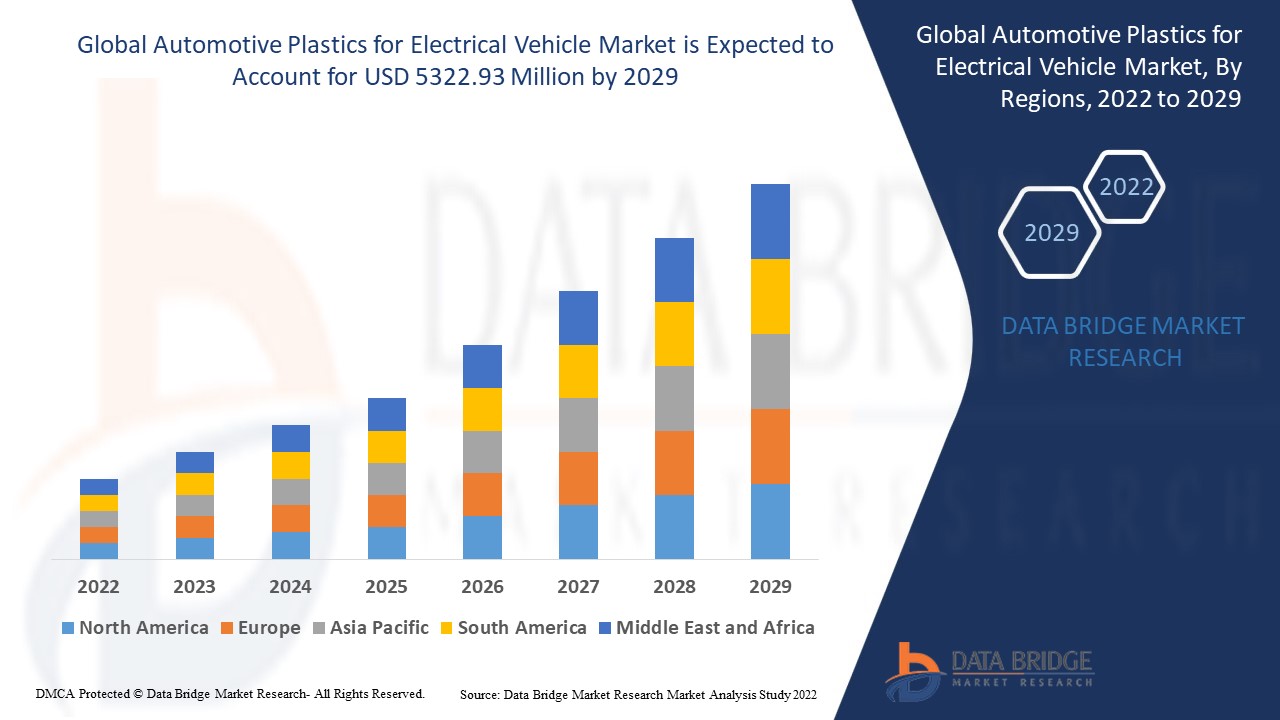
The Global Automotive Plastics for Electric Vehicle Market is witnessing strong growth as electric mobility accelerates worldwide. Plastics have become a crucial component in modern electric vehicles (EVs), offering lightweight properties, design flexibility, corrosion resistance, and cost-effectiveness. With the global EV industry expanding rapidly, the demand for advanced plastic materials to enhance efficiency, reduce vehicle weight, and improve sustainability is surging.
Data Bridge Market Research analyses that the automotive plastics for electrical vehicle market is expected to undergo a CAGR of 27.40% during the forecast period. Automakers are increasingly turning to high-performance plastics for applications ranging from battery casings and interior components to structural parts. The shift toward clean energy transportation and stringent emission regulations are key factors fueling this demand.
The Automotive Plastics for Electric Vehicle Market is driven by the growing adoption of EVs across global markets. Weight reduction is a critical priority for automakers, as lighter vehicles require less energy and extend driving range. Plastics are replacing metals in several applications due to their high strength-to-weight ratio.
In addition, advancements in polymer technologies are enabling the production of materials that can withstand high temperatures, provide excellent insulation, and offer improved safety. These properties are particularly important in battery systems, wiring harnesses, and thermal management solutions in EVs.
Government regulations to reduce vehicle emissions and improve fuel efficiency further strengthen the market outlook. Subsidies and incentives for EV adoption in regions such as Europe, Asia-Pacific, and North America are also encouraging automakers to scale up production and incorporate more plastic-based components.
However, challenges such as recycling limitations, environmental concerns regarding plastic waste, and fluctuating raw material prices remain hurdles. Nonetheless, opportunities lie in the development of bio-based and recyclable plastics, which align with sustainability goals while meeting the rising demand from the EV industry.
The Global Automotive Plastics for Electric Vehicle Market can be segmented by material type, application, and vehicle type.
By material type, the market includes polypropylene (PP), polyurethane (PU), acrylonitrile butadiene styrene (ABS), polycarbonate (PC), polyvinyl chloride (PVC), polyamide (PA), and other engineering plastics. Polypropylene and ABS dominate the market due to their versatility and strength, while advanced engineering plastics are increasingly used in high-performance EV applications.
By application, the market spans interior components, exterior body panels, under-the-hood parts, and battery systems. Interiors hold the largest share, as plastics are widely used in dashboards, seat components, and trim. Battery casings and structural reinforcements are growing applications as the EV market scales.
By vehicle type, passenger electric vehicles represent the largest demand segment, driven by high production volumes and rising consumer adoption. Commercial electric vehicles, including buses, trucks, and vans, are also contributing to growth as fleet electrification gains momentum worldwide.
The Automotive Plastics for Electric Vehicle Market shows diverse trends across global regions.
North America is a key market, supported by strong EV adoption in the United States and Canada. The presence of leading EV manufacturers, investments in battery production, and government incentives drive demand for high-performance plastics.
Europe is at the forefront of EV innovation, with countries like Germany, France, and the UK pushing for electrification and stricter emission standards. The region’s strong automotive ecosystem and sustainability focus support the expansion of plastics use in electric mobility.
Asia-Pacific is the fastest-growing market, led by China, Japan, South Korea, and India. China’s dominance in EV production, coupled with large-scale government initiatives, makes it the largest consumer of automotive plastics for EV applications. Japan and South Korea, with advanced materials and automotive expertise, further enhance regional growth.
The Middle East and Africa are witnessing gradual adoption, particularly in the UAE and South Africa, where EV infrastructure is improving. South America, led by Brazil, is also emerging, with rising EV penetration supported by government initiatives.