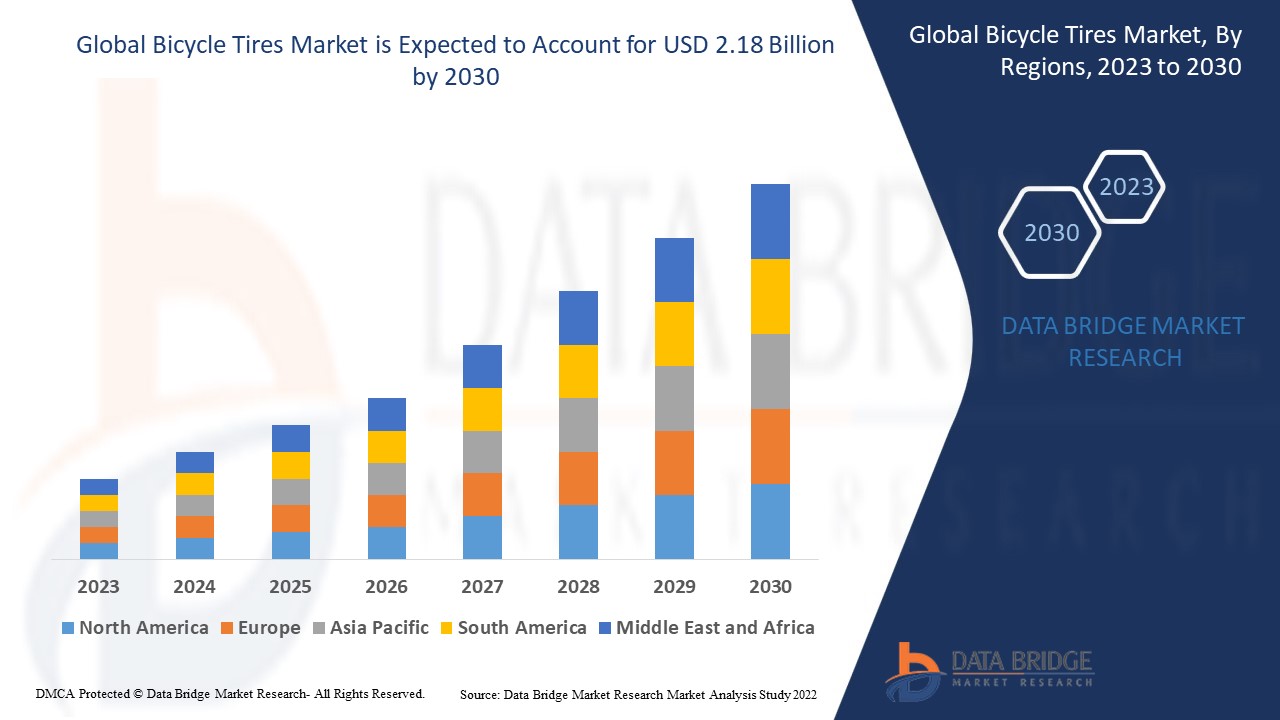
The Global Bicycle Tires Market is experiencing rapid expansion as cycling gains popularity for commuting, recreation, sports, and fitness. Bicycle tires are one of the most critical components of a bicycle, directly impacting performance, safety, and riding comfort. Advances in material technology, growing environmental awareness, and the global shift toward sustainable and healthy mobility solutions are fueling demand for high-quality tires.
Data Bridge Market Research analyses that the bicycle tires market was valued at USD 1.34 billion in 2022 and is expected to reach the value of USD 2.18 billion by 2030, at a CAGR of 6.30% during the forecast period. With rising urban congestion, increased government investments in cycling infrastructure, and surging participation in cycling sports, the demand for durable, lightweight, and eco-friendly tires is set to accelerate worldwide.
The Bicycle Tires Market is driven by multiple growth factors. The rising adoption of bicycles as a sustainable mode of transportation is one of the primary drivers. Governments across Europe, Asia, and North America are encouraging cycling to reduce carbon emissions, improve public health, and tackle traffic congestion.
The popularity of cycling for fitness and recreation has also boosted demand for specialized tires designed for road bikes, mountain bikes, and hybrid bikes. Electric bicycles (e-bikes) are emerging as a major growth segment, requiring tires with higher durability and load-bearing capacity to support motorized systems.
However, the market faces challenges such as price volatility of raw materials like rubber, high competition among regional manufacturers, and maintenance costs associated with frequent tire replacements. Despite these hurdles, opportunities exist in the growing demand for smart tires with integrated sensors, as well as in the development of eco-friendly, recyclable, and puncture-resistant tires.
The Global Bicycle Tires Market can be segmented by product type, tire type, distribution channel, and end-user.
By product type, the market is divided into road bike tires, mountain bike tires, hybrid bike tires, and specialty tires. Road bike tires dominate due to rising adoption in urban commuting and competitive cycling. Mountain bike tires are also growing quickly as off-road and adventure sports gain popularity.
By tire type, the market includes tubed tires, tubeless tires, and solid tires. Tubed tires remain widely used, but tubeless tires are increasingly popular due to their better performance, puncture resistance, and reduced rolling resistance. Solid tires, though niche, are gaining attention for maintenance-free and urban commuting applications.
By distribution channel, the market is segmented into online and offline sales. Offline retail, including specialty bike shops and sporting goods stores, continues to hold a major share, while online platforms are rapidly growing due to convenience, wide variety, and rising e-commerce penetration.
By end-user, the market caters to professional cyclists, recreational riders, and daily commuters. The commuter segment leads, particularly in Asia and Europe, where bicycles are a primary means of transport.
The Bicycle Tires Market exhibits distinct regional growth trends.
North America is witnessing strong demand, driven by increasing participation in cycling sports and rising adoption of e-bikes. The U.S. and Canada are investing in cycling infrastructure, boosting tire sales across commuting and recreational segments.
Europe dominates the global market, supported by high bicycle ownership rates, government initiatives promoting sustainable transport, and well-developed cycling infrastructure. Countries such as the Netherlands, Germany, Denmark, and France lead in adoption, with strong demand for both commuter and high-performance bicycle tires.
Asia-Pacific is the fastest-growing region, with China, India, and Japan leading demand. Rapid urbanization, cost-effective mobility solutions, and the booming e-bike industry are major contributors. China is the world’s largest producer and consumer of bicycle tires, while India’s cycling culture is expanding rapidly in both urban and rural areas.
The Middle East and Africa are gradually embracing bicycles as an affordable and eco-friendly transportation mode, particularly in urban centers. South America, led by Brazil, is also showing strong potential, driven by increasing health awareness and cycling sports.